
Guide
Interactive content for universities.
Short stories students tap through on their phone, in place of the brochure, the long page and the newsletter. Here is what interactive content is, why it holds attention, and where it works at each stage of the student journey.
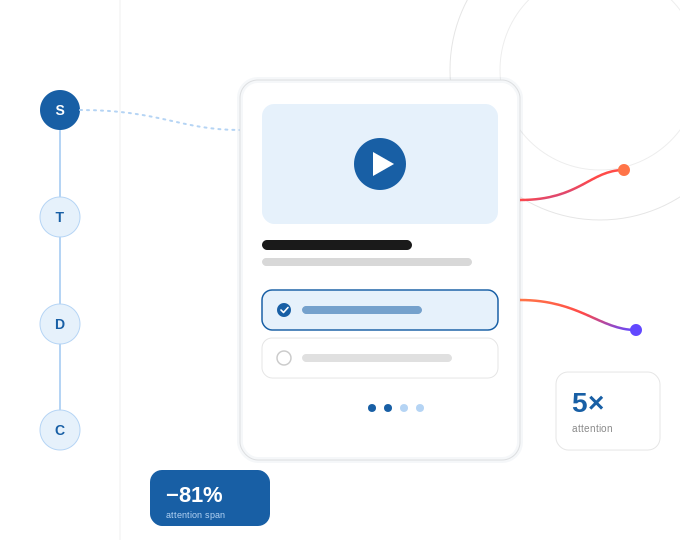
What is interactive content for universities?
Interactive content for universities is communication that prospective and current students take part in rather than scroll past: short stories they tap through, quizzes that give them a personal result, tours they steer and choices that change what they see next. Each piece answers one question, asks for one small action at a time and ends on one next step, so students finish it on a phone and the university learns what they chose along the way.
That is the difference from a brochure, a long programme page or a newsletter, which all ask students to read and work out the answer for themselves. Below is why interactive content holds attention, what it looks like at each stage of See, Think, Do and Care, and how to start with one piece.
What counts as interactive content?
Anything where the student's input shapes the experience. In higher education that usually means one of these formats:
- Interactive stories. Short chapters in a social media style, each a video, image or a few lines of text paired with a tap, a poll or a choice.
- Quizzes and finders. Four to ten questions that end in a personal result, such as the field or programme that fits.
- Virtual tours. A campus or city explored in a guided order, with stops students choose to open.
- Interactive brochures and guides. A programme, a welcome or a practical topic split into chapters students pick from, instead of one PDF.
- Short surveys. Questions asked one at a time in story form, so students finish them.
What these formats share is that every tap is a signal. You see which chapters students opened, where they stopped and what they answered, as first-party data you can pass to your CRM.
Where does interactive content work in the student journey?
At every stage, because each stage has its own question. Here is one real example for each.
See: attract the right prospective students
The question at this stage is "why should I look at you?". The University of Amsterdam wanted national and international students to get a sneak peek of all its campuses, so it plotted stories on a map of the city. Each tour links out to the programmes and orientation events on that campus. 96% of viewers were engaged, and 40% dived deeper via an in-story link.
A virtual tour like this earns attention from students who have not yet visited and points them to the next step. You can see how it works in our virtual campus tour concept. For campaigns, the same idea works as a short quiz behind your ads: see university lead generation.
Think: help students choose the right programme
The question here is "is this programme right for me?". Eindhoven University of Technology (TU/e) wanted prospective students to really understand what a master's programme involves before they apply. Instead of a static PDF, it built an interactive brochure covering the content, the structure, the career paths and what is genuinely expected of students. The students who apply do so with confidence, because they have seen an honest picture of the fit.
That is the job of interactive content at the Think stage: fewer wrong-fit applicants, better-fit students. See the interactive study brochure concept, or the programme finder for students who are still choosing between programmes.
Do: turn offer holders into enrolled students
The question now is "can I actually make this work?". For international students, finding a room in a tight housing market is one of the most stressful parts of moving abroad. Radboud University answered it with a pre-boarding story: a realistic picture of the market and a step-by-step guide to finding a room, where to look and what to watch out for. It averages 9 interactions per session and is part of a series of subject-based pre-boarding stories.
Every question answered before doubt sets in is one less reason not to show up. See the pre-boarding concept.
Care: keep new students engaged, and keep them enrolled
The question in the first weeks is "where do I find what I need?". In the days before they start, new students get a flood of emails, PDFs and handovers. TU Delft replaced that with a simple "Welcome to TU Delft" guide: the practical information in one place, linking to its app and other sources for the detail. It averages 13 interactions per session, and 100% clicked through for more info.
How do you start with interactive content?
- Pick the stage that worries you most. Too few leads, wrong-fit applicants, offer holders who don't show up or first-years who drift away.
- Choose one question students have at that stage. "Which programme fits me?" or "How do I find a room?" is better than "everything about us".
- Replace one static piece, not all of them. A brochure, a welcome email or a campaign landing page is a good first candidate.
- Keep it short. A few chapters, one interaction each, one next step at the end.
- Put it where students already are. Your website, your campaigns, an email, a QR code at an open day.
- Measure completion and the next step. Then build the next piece for the next stage.
Interactive content questions.
Interactive storytelling is one form of interactive content: a story told in short chapters where the student taps, chooses or answers along the way. Interactive content also covers quizzes, finders, tours and surveys. In higher education, most of these work best told as a story, because students finish stories.
No. It sits on your website, in your campaigns and in your emails, and it sends what students chose to the CRM your team already uses, such as Microsoft Dynamics, Slate or Salesforce Education. Your website stays the place for the full detail; the story is the part students actually get through.
Look at completion (how many students reach the end), interactions per session and the next step taken: a lead form, an open day sign-up, an application or a click through for more information. Because every tap is recorded, you can see where students drop off and fix that chapter.
No. Most stories are built from material you already have: photos, short phone videos from students and staff, and the text from your current brochure or welcome pack, split into chapters. The format does the work of making it engaging.
Find the stage where attention drops
Tell us which stage of the student journey worries you most. We'll show you what other universities built for it, and be honest about whether we're the right fit.