
Compare
The right tool for every student journey stage.
A plain guide to what universities use to attract, guide, convert and keep students, and where StudentJourney fits alongside it.
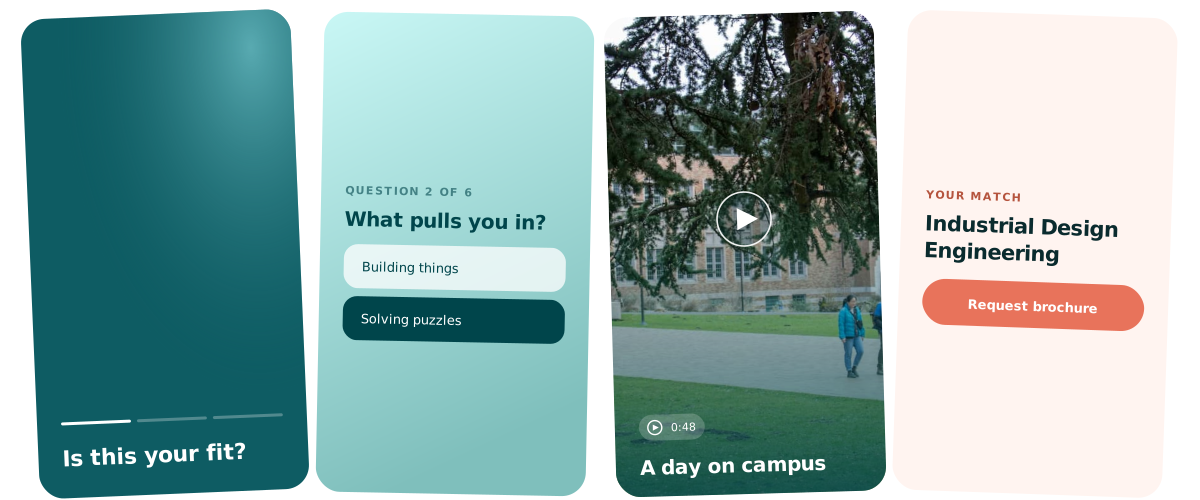
Which tool for which stage of the student journey?
Most student journey tools are built for one stage. Virtual tour platforms help students discover your campus, programme matchers and digital prospectuses help them choose, and peer chat platforms help them decide and arrive. StudentJourney turns your key messages into interactive stories at every stage, and works alongside the specialists you already use.

Tools that help students discover you.
At this stage students do not know you yet, so the job is to earn their attention and their details. Universities usually combine campaigns and social media with a way to explore the campus from anywhere. The tools below are built for that first look.
- Virtual tour platforms. Concept3D offers 360° tours and interactive campus maps, and says it is built for colleges and universities. EAB's Appily Virtual Tours, which grew out of YouVisit, adds an AI Tour Navigator that answers students' questions and a conversational enquiry form. Best at: a full, immersive picture of the campus.
- Programme matching as lead generation. House of Education's Digital Advisor sits on your website and landing pages and is also used for lead generation. Best at: capturing leads with their programme interests attached.
- Peer content. Unibuddy embeds ambassador-generated content and profiles to capture attention early. Best at: putting real student faces on your site from the first visit.
- Where StudentJourney fits. Story-led campus tours and short interest quizzes that run behind campaigns and on your own site. The University of Amsterdam plotted campus stories on a map of the city: 96% of viewers were engaged and 40% dived deeper via an in-story link.
Tools that help students choose a programme.
Now students are comparing options and asking whether a programme fits them. The tools here help them explore programmes in depth and self-select before they apply, which saves your admissions team time.
- Programme matching. House of Education's Digital Advisor helps prospective students explore and compare your programmes and guides them to the right fit. Best at: matching students to programmes; the case studies on its site come from business schools.
- Digital prospectus and interactive documents. Foleon is a content platform used across many industries, and for universities it builds viewbooks, brochures and prospectuses with page-by-page analytics. eduKUDU's theRACK is built only for higher education and replaces PDF prospectuses with mobile-first, trackable publications, for 75+ universities. Best at: the full prospectus and course catalogue, kept up to date.
- Peer chat. Unibuddy and TAP let prospective students talk to current students and ambassadors while they decide. Best at: answering one student's personal questions.
- Where StudentJourney fits. A programme matcher and an interactive brochure per programme, in a vertical story format. The University of Groningen runs 1 general interest and 11 specific faculty quizzes, with a 72% quiz completion rate. TU/e replaced a static PDF with an interactive brochure for a master's programme.
Tools that turn offers into enrolments.
Between offer and arrival, students need reassurance and clear next steps, or they drift to another offer. This is where housing, visas and belonging start to matter as much as the programme.
- Offer-holder communities. TAP builds communities of offer holders so friendships form before arrival. Unibuddy gives students a community space with peers, ambassadors and your team before term starts, plus onboarding task lists and timelines. Best at: belonging and live peer support before arrival.
- Apps for international students. Community platforms such as Goin' give new arrivals a place to look for guidance about life in their new country. Best at: practical support for international students in one app.
- Where StudentJourney fits. Pre-boarding stories that make the hardest practical steps clear. Radboud University built a step-by-step guide to finding a student room in a tight housing market, with an average of 9 interactions per session, as part of a series of subject based pre-boarding stories.
Tools that help students settle in and stay.
Once students arrive, the challenge is getting them to read what matters, at the moment it matters. Many universities use a mix of email, apps, event calendars and PDF guides.
- Event calendars and campus maps. Concept3D's Localist Events is a centralised events calendar, alongside its interactive maps. Best at: helping students find events and places on campus.
- Interactive documents. Foleon lists student handbooks and newsletters among its higher education formats. Best at: long-form publications in a branded, digital format.
- Where StudentJourney fits. Welcome stories and campus updates that bring practical information together and link to the detail. TU Delft built a "Welcome to TU Delft" guide for new students: an average of 13 interactions per session, and 100% clicked through for more info.
Where StudentJourney works alongside other tools.
StudentJourney is not built for live peer chat. Peer-to-peer conversation is Unibuddy's and TAP's job, and both are built for it. StudentJourney works alongside them: stories reach every visitor with the same clear message, and a chat link in the story hands the student to a real ambassador when they want a personal answer.
The same goes for other specialists. If you need a full 360° campus tour, a virtual tour platform is the better fit. If you publish a full print-style prospectus or a research magazine, a document platform such as Foleon is built for that. StudentJourney is for the short, interactive moments that guide a student to the next step, on your own website and channels.
Our partnership with Goin' shows how this works in practice. Together we created a "Welcome to the Netherlands" story delivered inside the Goin app, used by more than 40 nationalities, with on average 14 interactions per session.
Student journey tool questions.
It works alongside it. Unibuddy and TAP are built for peer-to-peer conversation: prospective students chatting with current students and ambassadors. StudentJourney is not built for live chat. It turns your key messages into interactive stories that every visitor sees, such as a campus tour, a programme quiz or a pre-boarding guide, and a story can link to your ambassador chat when a student wants a personal answer.
Foleon is a content platform for interactive documents and microsites across many industries, and in higher education it is used for viewbooks, brochures and prospectuses. StudentJourney is built only for the student journey and uses a vertical, tap-through story format with quizzes and branching. A Foleon document suits a full prospectus. A StudentJourney story suits a short, guided moment, such as one programme's brochure ending on an open day sign-up.
At the See stage, virtual tour platforms such as Concept3D and EAB's Appily Virtual Tours. At Think, programme matchers such as House of Education and digital prospectus tools such as Foleon and eduKUDU. At Do, peer platforms such as Unibuddy and TAP. At Care, event calendars, apps and email. StudentJourney covers all four stages with one story format.
When the job is the specialist's core. Live conversations between students and ambassadors are what Unibuddy and TAP are built for. A full 360° campus tour is what Concept3D and EAB's virtual tours are built for. A full print-style prospectus or magazine suits Foleon or eduKUDU. StudentJourney is the better fit when you want one format and one team to guide students at every stage.
StudentJourney has two published plans. Team costs €9,680 a year and Collaboration costs €18,875 a year, both excluding VAT, with unlimited stories and onboarding, training and support included. For more than 15 users there is an Enterprise plan with custom pricing. The pricing page lists what each plan includes, or book a 20-minute discovery call to talk it through.
Map your student journey with us.
In a 20-minute discovery call we look at the stages where your students drop off, the tools you already use, and where an interactive story would help most.