
Concept / SEE
A virtual campus tour students actually finish.
An interactive story or map that walks prospective students through your campus, city and student life, from anywhere in the world. No 360 shoot needed.
What is an interactive virtual campus tour?
An interactive virtual campus tour is a story-format tour of your campus that prospective students explore on their phone or laptop. They choose where to go, watch short videos from current students and pick up practical information along the way. It reaches students who cannot visit, and it shows you what each of them explored.
Unlike a 360 photo tour, it is built from the photos and videos you already have, combined with interactive elements. It is designed to be finished though a guided tour, or that users are completely free about what they explore (open world). Universities use it as a 24/7 recruitment asset in every market they recruit from, without the cost of a physical event.
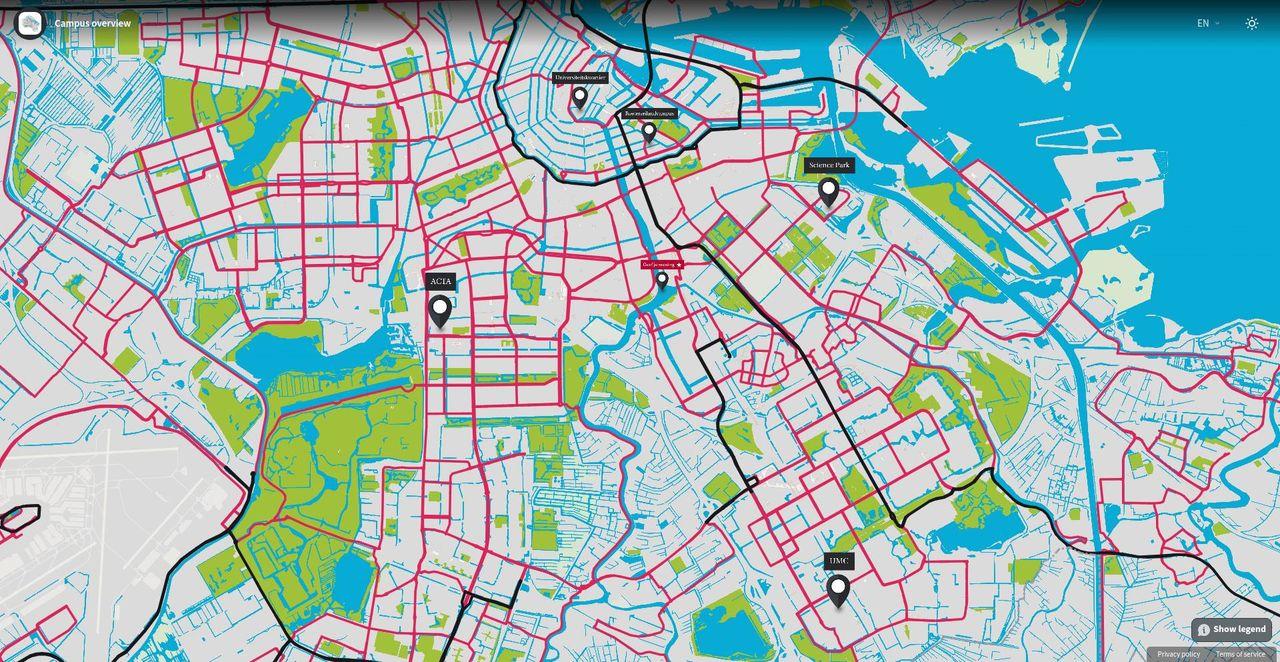
The University of Amsterdam combines an open world showing all their campuses and when you click on one a guided tour starts.
Why most virtual tours lose students halfway.
Many prospective students decide without ever visiting, international students most of all. A virtual tour is often their only look at your campus, and most formats are not built to hold their attention:
- 360 photo tours are expensive to shoot, quick to date and easy to click away from.
- A map full of markers gives students no reason to keep going, and no route to your programmes or open day.
- You rarely know who explored what, so the tour does nothing for your follow-up.
How it works
Three variations of virtual tours
And these options can also be combined
Students land on an interactive campus map and choose what to discover. Every location opens its own layer of photos, videos, student quotes and practical info, explored at their own pace and in any order.
A curated narrative leads students from arrival through student life to programme discovery, branching on their choices, Bachelor or Master, campus or city, while always moving towards a clear call to action.
A tour that consists mostly of 360-degree photos and videos. This is generally a good option if you simply want to showcase your facilities.
Deploy everywhere
The tour embeds anywhere a link or iframe is supported: your website, open day pages, email, social, paid ads and QR codes at fairs. Build it once and roll it out to every channel.
Students finish them. UvA and NHL Stenden show how.
University of Amsterdam's campus stories, plotted on a map of the city
UvA viewers who followed an in-story link to programmes and events
NHL Stenden's guided tour, 12 interactions per session on average
A campus students can feel, not just a gallery they scroll.
- Students explore, interact and choose their path
- Guided or open-world, tailored to their study
- Engagement data at every step
- A 24/7 recruitment asset for every market
- A gallery students click through passively
- The same experience for every visitor
- No idea who engaged, or how
- Only useful once they already plan to visit
Virtual campus tour questions.
Yes, if students finish it. For many international students a tour is the only look at your campus they get before applying. The University of Amsterdam's story-format tour kept 96% of viewers engaged, and 40% followed a link from inside the tour to programmes and events.
No. A story-format tour is built from the photos, short videos and student quotes you already have, or that your students film on a phone. That also makes it quick to update when a building, a programme or an event changes.
Short, guided steps on a phone, with a choice to make every few screens. A linear tour with a guide works well for a first look: NHL Stenden's averages 12 interactions per session and holds a 4.9 rating from 1,992 reviews. An open map suits students who already know what they want to see.
Anywhere a link or iframe works: your website, open day pages, emails, social media, paid ads and QR codes at student fairs.
Yes. We shape the concept and framework with you and train your team to finish it, so you can adjust, expand and copy the tour yourselves.
Yes. Every step is measured, so you can see where students go, how far they get and who shares their details, and use that in your follow-up.
How we build it together.
Start with the scope: a guided storyline, an open-world map, or both, and the locations and stories worth featuring. We generally recommend beginning with the handful of places that matter most to prospective students, rather than mapping the whole campus at once. From there, we shape the concept and framework together and train your team to finish it, so you can adjust, expand and copy the tour yourself with ease.