
Concept / THINK
A programme finder students actually finish.
Five to ten questions lead each prospective student to a shortlist of programmes that fit, so the students who apply chose you for the right reasons.
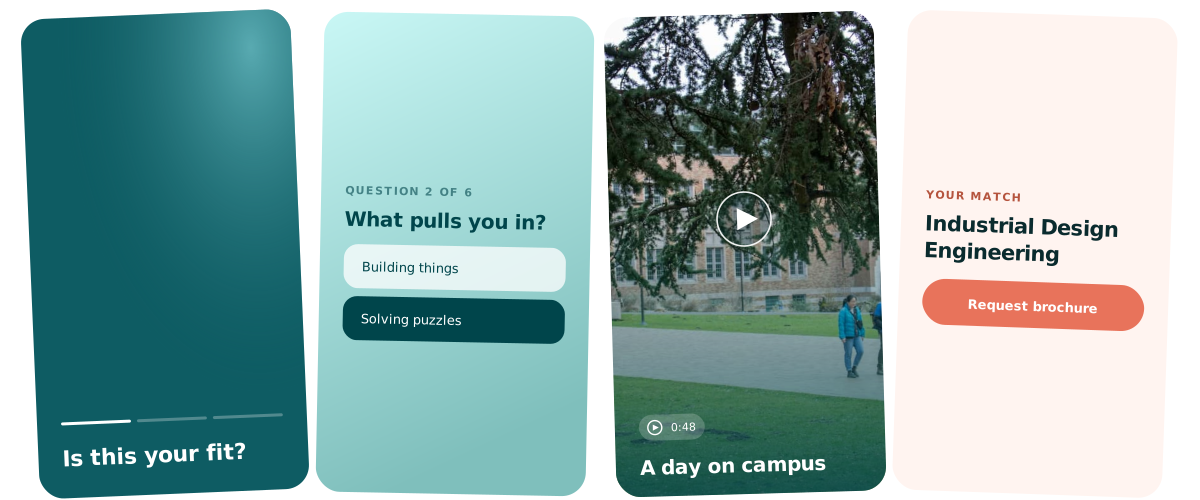
What is a programme finder?
A programme finder, also called a programme matcher or study choice quiz, asks prospective students a handful of questions about their interests, strengths and ambitions, and matches the answers to your programmes. Instead of one verdict, each student gets a personal shortlist of the three to five programmes that suit them best.
It answers the question students ask before they apply: which programme is right for me? Undecided students find a programme they had not considered, and students who were never a fit see it before they apply, not after they enrol. Every result links to what comes next: a programme video, a landing page or an interactive brochure.

Try it live: how the University of Groningen starts study choice.
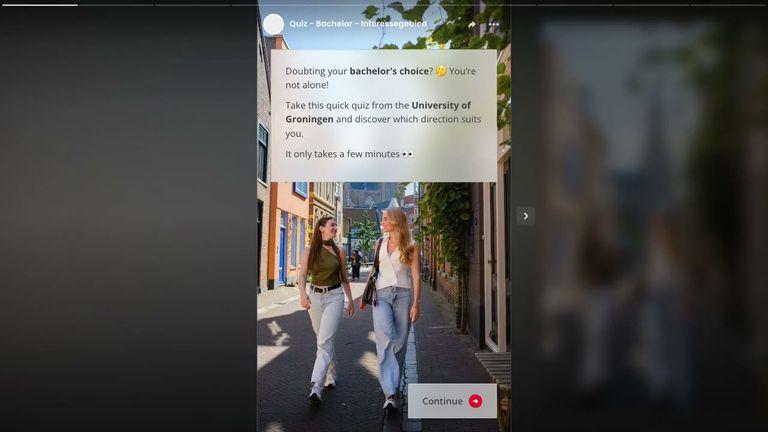
Click to open the story, just as a student would see it.
Why study choice tests lose students halfway.
Most study choice tests are built like forms, and they lose students in the same few ways:
- Dozens of questions, because one test tries to cover every programme in the university.
- A form-like interface that feels like admin, not like finding out something about yourself.
- A single result on a plain page, and nowhere to go if the student disagrees with it.
- No data back, so admissions never learns which programmes students were matched to.
The cost shows up later, in applications from students who picked the wrong programme and in first-year drop-out that could have been avoided.
Two levels
Field first, then programme.
Run one level or both. The University of Groningen runs a general interest quiz behind its campaigns and 11 faculty quizzes on its website, each working on its own or back to back.
For students who don't yet know their direction. A handful of questions points them to the faculty or field that suits them, on your website or behind a recruitment campaign.
For students who know their broad direction. A personal top 3 or 5 programmes, each linked to its programme page, video or brochure, so they can explore the matches straight away.
How it works
Four techniques, one confident shortlist.
A programme finder combines a handful of interactive techniques. Mix them to fit your programmes and your audience.
Let students quickly like or dislike topics to reveal their interests.
Multiple-choice questions based on the differences between programmes.
Easily add logic that generates scores in the back-end and enables matching.
Link every result to a pitch video, landing page or interactive brochure.
Finished quizzes. Better-matched applicants.
Across the University of Groningen's study choice quizzes
Each zooms in on the right programme within a field
Short enough to finish on a phone
Students don't quit because they stopped caring. They quit because it's dull.
- 5-10 sharp questions, built to be finished
- Beautiful, on-brand, feels like an experience
- A personalised top 3 or 5 to explore
- Every result links to a video or page
- Interests and choices flow to your CRM
- Dozens of questions, high drop-off
- A dry, form-like interface
- One result on a clinical page
- A dead end with no next step
- No data back to your team
Programme finder questions.
Give them a short programme finder. Five to ten questions about their interests and goals lead to a personal top 3 or 5 programmes, each linked to its programme page, video or brochure. Students who fit apply with more confidence, and students who don't fit find out before they apply.
A programme matcher is an interactive quiz that scores a student's answers against your programmes and returns a shortlist of the best fits. Universities run one on programme pages, behind campaigns, at open days and on screens on campus, and send each result on to the programme's own page.
Help students self-select before they apply. A programme finder shows each student which programmes fit their interests, so fewer apply for a programme that was never right for them, and admissions spends less time on applications that go nowhere.
Five to ten. That is enough to separate your programmes without losing students. If one finder would need more to cover every programme, split it: a faculty or field quiz first, then a programme quiz within that field. The University of Groningen works this way and reports a 72% quiz completion rate.
Start with one. A field-level quiz suits students who don't yet know their direction, and a programme-level quiz suits students who do. We generally recommend against one institution-wide quiz, because it needs too many questions, unless you are a smaller university.
Yes. Each student's answers and matched programmes flow into the CRM your admissions team already runs, including Azorus, Microsoft Dynamics, Slate, TargetX and Salesforce Education, or a custom connection.
How we build it together.
Start with one choice: match students to a faculty or field, or to a specific programme. We generally recommend against going institution-wide in one go: too broad means too many questions, and the matcher loses its impact (unless you're a smaller university).
From there, we shape the concept and framework together and train your team to finish it, so you can adjust, expand and copy the concept yourself with ease. A first programme finder typically takes one to two weeks to build.