
Concept / SEE
University lead generation that brings in students who fit.
A short USP story earns the attention and a quiz turns it into a lead, so admissions knows what each student is looking for before the first email.
What is university lead generation?
University lead generation is how a university turns prospective students who notice it into contacts it can follow up with. The leads worth having are qualified: the student chose to share their details, and you know what they are interested in.
Interactive lead generation can take several forms, each designed to make the best possible first impression. For example, a short USP story gives students a reason to stay by creating a positive association with your university’s unique selling points, while a lead generation quiz helps them work out whether they fit your culture or programmes based on their interests.
Students share their details to receive their personal result or more information. These lead generation concepts can be integrated with CRM systems such as Salesforce, Azorus or Microsoft Dynamics, and form the starting point of a personalised student journey, with follow-up concepts that gather more and more information to build a richer profile of each student and tailor every next touchpoint.
Try it live: the University of Groningen's interest quiz.
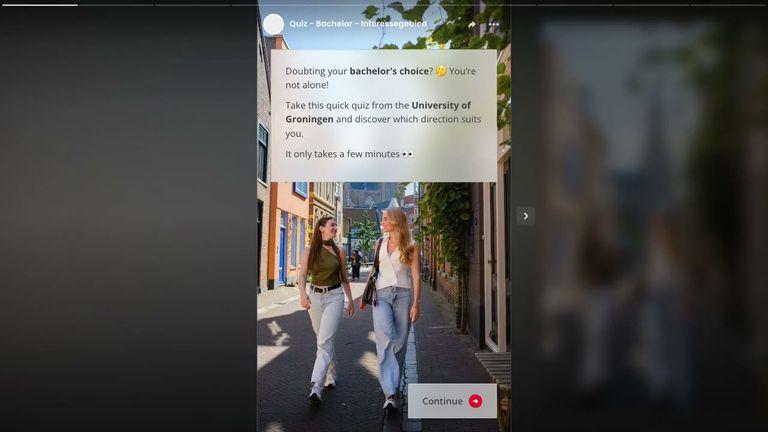
Click to open the story, just as a student would see it.
Why campaign leads so often go nowhere.
Recruitment campaigns are good at buying clicks. What happens after the click decides whether that budget turns into leads:
- Students scroll past a landing page that asks for attention without earning it, so the cost per lead climbs.
- Broad campaigns reach students who were never going to be a fit, inflating volume but not quality.
- A download form returns a name and an email address, and nothing your admissions team can follow up on.
How it works
Two formats, one lead your team can follow up.
A short story built around the three things that make your university, faculty or programme the right choice. Each strength gets its own chapter, a short video paired with a quick interaction, and the story ends on one next step.
Four to six questions help a student work out whether you fit. The lead form sits just before the result, when they are most motivated to share, so every lead arrives with their answers attached.
The result lands in the student's inbox and every answer flows into the CRM your admissions team already runs, so the next email can be about the field or programme they chose.
Students finish them. The University of Groningen shows how.
Across RUG's study choice quizzes, behind campaigns and on the website
1 general interest quiz and 11 faculty quizzes
An interest quiz behind the campaign, then a faculty quiz on the website
Leads who chose to tell you something, not clicks that bounce.
- Students self-select before they share details
- Details captured at the moment of most interest
- Every answer flows into your CRM
- One story and one quiz reused across campaigns
- A landing page paid clicks leave in seconds
- A download form with a name and nothing else
- Volume with no sense of fit
- A new landing page for every campaign
University lead generation questions.
Give students something worth finishing behind your campaigns. A short USP story shows them why you, and a lead generation quiz of four to six questions helps them work out whether they fit. They share their details to get their result, so every lead arrives with their interests attached.
The student chose to share their details, you know what they are interested in, and they have some sense of whether they fit. A brochure download form usually gives you only a name and an email address.
Both work. The University of Groningen runs a general interest quiz behind its campaigns that points students to a field, and 11 faculty quizzes on its website that zoom in on the right programme. Each works on its own or back to back, with a 72% quiz completion rate.
Four to six is enough to reveal fit without losing students. The lead form sits just before the result, when students are most motivated to share, so a quiz they abandon halfway produces no lead at all.
Yes. Student answers and contact details flow into the CRM your admissions team already runs, including Azorus, Microsoft Dynamics, Slate and Salesforce Education, or a custom connection.
Yes. We shape the concept and framework with you and train your team to finish it, so you can adjust, expand and copy the quiz and the story for other programmes and campaigns yourselves.
How we build it together.
Start with one campaign and one question worth answering for the students it targets. We generally recommend one interest quiz behind a single campaign, paired with a USP story for the faculty or programme it points to, then expanding once the leads prove out. From there, we shape the concept and framework together and train your team to finish it, so you can adjust, expand and copy it yourself with ease.